It's not me, it's you.
· Colin Ford
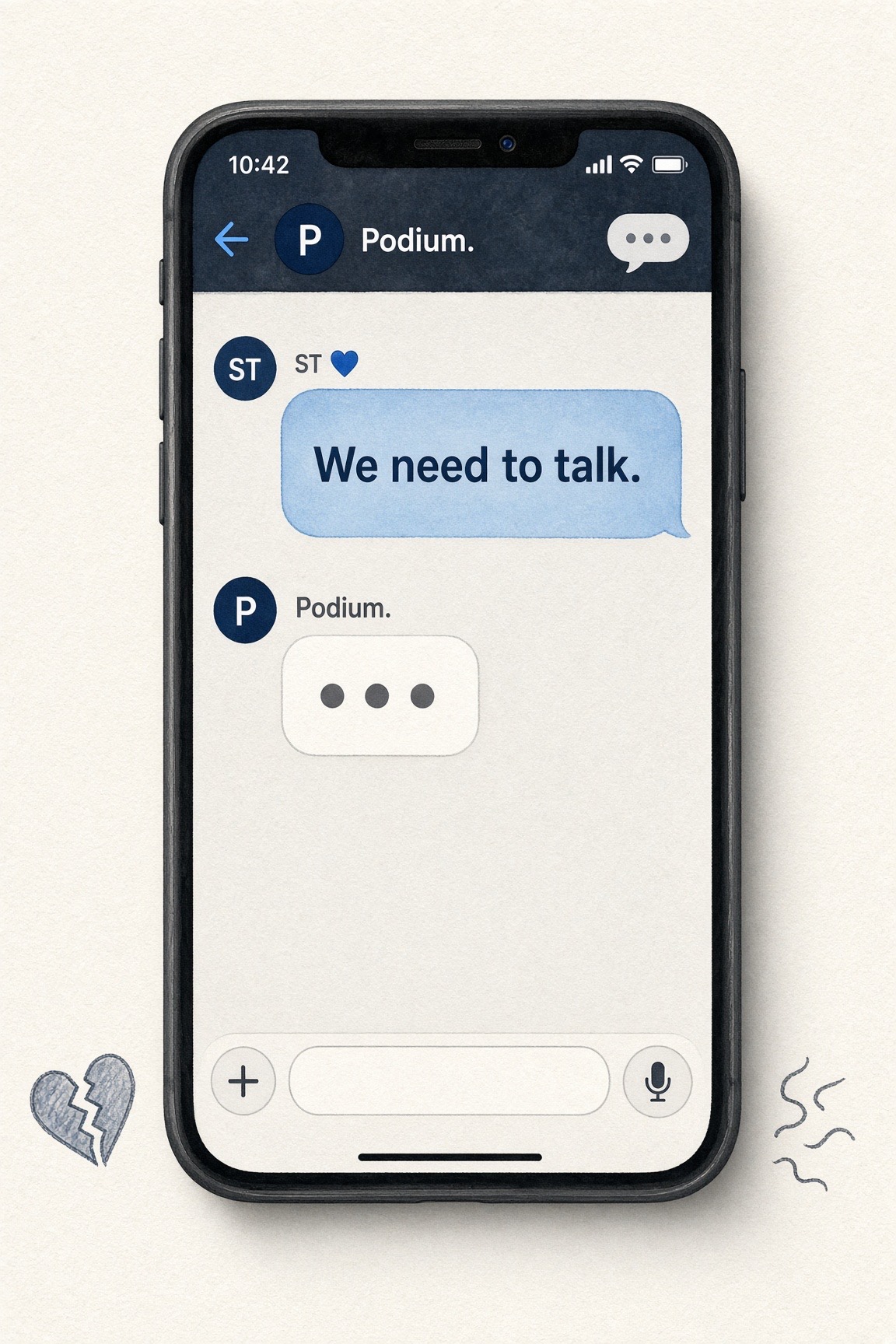
Earlier this month, Podium and ServiceTitan had a bit of a spat.
The net of it is that Podium doesn’t qualify for ServiceTitan’s certified partner program anymore. There’s a bit of he said she said from either side about why.
My read between the lines is this: because building software is cheaper than ever, the marketplace is only getting more competitive. Every workflow tool is expanding to cover other workflows and there seem to be 100 new players in every category. The home services “revenue agent” category is a great example - Probook, Broccoli, Avoca, ServiceTitan, Cactus all have well-funded products (there are more). Podium got the boot because they’re building competing products with others in ServiceTitan’s arsenal.
For customers, this is a double-edged sword: more competition means lower prices and better value. Wonderly offers a suite of products including revenue agents that are free until the customer starts to see a return. But more competition also means the market is overwhelming. If every vendor builds a solution for every problem, how do you differentiate them? And how do you protect yourself from being the victim of software integration warfare?
The good thing is that software is also cheaper than ever to manage on your own. I think home services contractors will increasingly employ in-house builders/operators to build resilience against breaking integrations and capture the value AI can deliver on its own data. An in-house team can maintain data exports and an integration map, build manual integrations, and ensure you have a plan for what happens when existing integrations break. They can also build bespoke software that covers the “last mile” of needs that aren’t covered by third parties. I wrote about this in detail on my site here.
For vendors, the most important takeaway is that you want to be seen as making your customer’s lives easier, not harder. Build open systems that allow your products to integrate with other tools. Prove your product’s superiority based on value. And that doesn’t mean you have to have the best product: Google Meet and Microsoft Teams were notably less exciting than Zoom, but they gained market share because they were bundled for free with other offerings. That strategy didn’t require Google and Microsoft to shut off their calendar integrations with Zoom.
Where am I wrong?